




Asbestos Management Plans: A Duty Holder’s Practical Guide
If you are responsible for managing a non-domestic building, ensuring asbestos is properly managed is a legal obligation, not just good practice. Schools, hospitals, offices, factories, retail units, and public buildings constructed before 2000 may still contain asbestos-containing materials (ACMs). When these materials remain undisturbed, they often present little immediate risk. However, if they are damaged during maintenance, refurbishment, or everyday activities, asbestos fibres can be released into the air, posing serious health risks.
An effective asbestos management plan helps organisations meet their legal duties while protecting employees, contractors and visitors from unnecessary asbestos exposure.
Under the Control of Asbestos Regulations 2012, those responsible for managing premises must identify, assess, monitor, and manage asbestos risks through a documented asbestos management plan.
This guide explains what an asbestos management plan is, who needs one, what it should contain, and how organisations can remain compliant with Regulation 4.
What Is an Asbestos Management Plan?
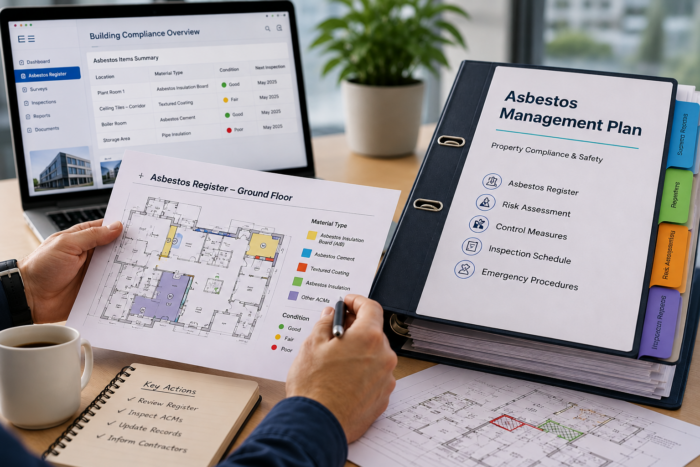
An asbestos management plan is one of the most important documents in a property’s health and safety records. It transforms the findings of an asbestos survey into a practical system that helps organisations manage asbestos risks on an ongoing basis.
A compliant management plan provides clear instructions on:
- Where asbestos is located
- The condition of asbestos-containing materials
- The level of risk they present
- Who is responsible for managing them
- How contractors will be informed
- When inspections should take place
- What action should be taken if materials become damaged
Why Is an Asbestos Management Plan Important?
An asbestos management plan helps organisations:
- Meet their legal obligations under the Control of Asbestos Regulations 2012
- Protect employees, contractors, occupants, and visitors
- Reduce the likelihood of accidental asbestos disturbance
- Demonstrate compliance during HSE inspections
- Support planned maintenance and refurbishment projects
For many organisations, the management plan becomes the central document used by facilities managers, estates teams, health and safety officers, and maintenance contractors.
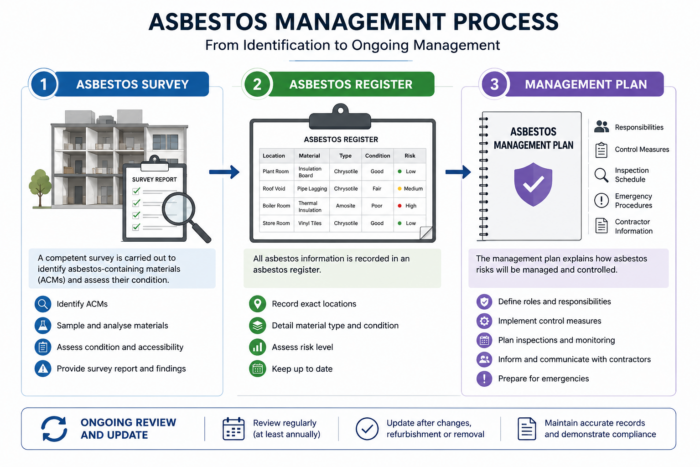
Asbestos Survey vs Asbestos Register vs Management Plan
These documents are often confused, but each serves a different purpose.
| Document | Purpose |
| Asbestos Management Survey | Identifies asbestos-containing materials and assesses their condition. |
| Asbestos Register | Records the location, type, condition, and risk of identified asbestos. |
| Asbestos Management Plan | Explains how the asbestos identified in the survey and register will be safely managed over time. |
Understanding Regulation 4: The Duty to Manage Asbestos
Regulation 4 is commonly known as the Duty to Manage Asbestos.
It applies to almost every non-domestic property built before the year 2000, where asbestos-containing materials could still be present.
The regulation requires duty holders to take a proactive approach rather than waiting until asbestos becomes a problem.
Key responsibilities include:
- Determining whether asbestos is present.
- Identifying its location and condition.
- Assessing the risk posed by asbestos-containing materials.
- Maintaining an up-to-date asbestos register.
- Preparing and implementing an asbestos management plan.
- Informing anyone likely to disturb asbestos, including maintenance teams and contractors.
- Reviewing and updating the management plan regularly.
Failure to comply can result in enforcement action by the Health and Safety Executive (HSE), including Improvement Notices, Prohibition Notices, fines, and, in serious cases, prosecution.
Who Is the Duty Holder?
Quick Answer
A duty holder is the person or organisation responsible for maintaining or repairing non-domestic premises. This responsibility may fall to building owners, landlords, employers, facilities managers, managing agents, or others with contractual responsibility for the building.
The legal duty does not automatically rest with the building owner.
Responsibility depends on who has control over the maintenance and repair of the premises.
Duty holders commonly include:
- Commercial landlords
- Property and facilities managers
- Local authorities
- NHS Trusts
- Schools and academy trusts
- Commercial property owners and employers
In many cases, more than one organisation may share responsibility. Lease agreements, maintenance contracts, and property management arrangements should clearly define who is responsible for asbestos management.
Where responsibilities are shared, effective communication is essential to ensure nothing is overlooked.
Responsibilities of a Duty Holder
Duty holders are expected to establish a structured system for managing asbestos throughout the lifecycle of a building.
Their responsibilities typically include:
- Arranging an appropriate asbestos management survey.
- Maintaining an accurate asbestos register.
- Producing and implementing an asbestos management plan.
- Informing contractors before work begins.
- Arranging periodic re-inspection surveys.
- Recording any changes in the condition of asbestos-containing materials.
- Reviewing the management plan regularly.
- Keeping records accessible for maintenance staff and contractors.
- Ensuring appropriate asbestos awareness training is provided where required.
By following these steps, organisations can reduce the risk of accidental exposure while demonstrating compliance with their legal duties.
What Should a Compliant Asbestos Management Plan Include?
Quick Answer
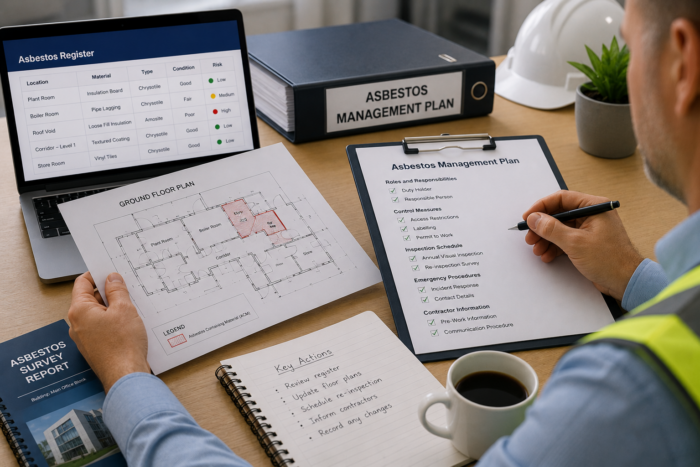
A compliant asbestos management plan should clearly explain how asbestos risks will be managed within a building. It should include the asbestos register, risk assessments, responsibilities, inspection schedules, emergency procedures, and a programme for reviewing and updating the plan.
An effective asbestos management plan is more than a folder containing survey results. It is a practical document that helps duty holders, facilities managers, contractors, and maintenance teams understand how asbestos will be managed throughout the building’s lifecycle.
While every building is different, a robust management plan should include the following key elements.
1. Building Information
Include the building address, use, duty holder, responsible person and review date.
Include details such as:
- Property name and address
- Building use (e.g. school, office, hospital, warehouse)
- Year of construction (if known)
- Number of floors or buildings covered
- Duty holder details
- Facilities manager or responsible person
- Date the management plan was created
- Current review date
This information ensures there is no ambiguity, particularly for organisations managing multiple sites.
2. Summary of the Asbestos Management Survey
Every management plan should reference the findings of the latest Asbestos Management Survey, including:
- Presumed asbestos-containing materials (ACMs)
- Laboratory-confirmed ACMs
- Material condition
- Accessibility
- Likelihood of disturbance
Rather than reproducing the full survey, provide a concise summary and reference the complete report where appropriate.
3. Asbestos Register
The asbestos register forms the foundation of the management plan.
It should record:
- Exact location of each ACM
- Product type
- Asbestos type (where known)
- Material assessment score
- Condition
- Accessibility
- Risk category
- Recommended action
- Date inspected
4. Risk Assessments
A compliant plan should include both:
Material Risk Assessment
This considers the condition of the asbestos itself, including:
- Surface treatment
- Extent of damage
- Product type
- Fibre release potential
Priority Risk Assessment
This considers how likely the material is to be disturbed based on factors such as:
- Occupancy
- Frequency of access
- Maintenance activities
- Building use
- Vulnerability of occupants
Combining both assessments helps determine whether asbestos should be monitored, encapsulated, repaired, or removed.
5. Roles and Responsibilities
One of the most common reasons management plans fail is because nobody is clearly responsible for implementing them.
The document should identify:
- Duty Holder
- Facilities Manager
- Maintenance Team
- External Asbestos Consultant
Each person’s responsibilities should be clearly defined to ensure accountability.
6. Control Measures
The plan should explain how asbestos exposure will be prevented.
Typical control measures include:
- Restricting access to high-risk areas
- Clearly labelling asbestos where appropriate
- Using permit-to-work systems
- Preventing unauthorised maintenance
- Monitoring damaged materials
- Scheduling repairs or removal where necessary
The aim is to minimise the likelihood of disturbing asbestos during everyday operations.
7. Contractor Communication Procedures
Before any maintenance, refurbishment, or installation work begins, contractors should be informed about the presence of asbestos.
The management plan should explain:
- How contractors access the asbestos register
- Who authorises work
- When refurbishment surveys are required
- How asbestos information is communicated before work starts
Failing to provide this information significantly increases the risk of accidental asbestos disturbance.
8. Emergency Procedures
Even with robust management, unexpected incidents can occur.
The plan should outline the steps to take if asbestos-containing materials are accidentally damaged, including:
- Stop work immediately.
- Secure the area.
- Report the incident.
- Arrange professional assessment.
Having clear procedures helps minimise disruption and protects everyone on site.
9. Inspection and Monitoring Schedule
An asbestos management plan should not remain unchanged after it is written.
Include a schedule showing:
- Planned visual inspections
- Re-inspection survey dates
- Areas requiring closer monitoring
- Previous inspection outcomes
- Future review dates
Regular inspections help identify deterioration before asbestos becomes a significant risk.
10. Training and Awareness
Anyone who may encounter asbestos during their work should receive appropriate information and training.
Depending on the organisation, this may include:
- Caretakers
- Maintenance staff
- Electricians
- Plumbers
- HVAC engineers
- Facilities teams
- Contractors
- Estates managers
Training helps ensure asbestos-containing materials are recognised and managed safely.
11. Planned Remedial Actions
The management plan should clearly document any actions required to reduce asbestos risks.
Examples include:
- Encapsulation
- Repair
- Removal
- Increased monitoring
12. Record Keeping
An effective management plan should maintain a complete audit trail.
Keep records of:
- Survey reports
- Inspection reports
- Re-inspection surveys
- Air monitoring certificates
- Removal certificates
- Contractor notifications
- Maintenance work
- Incident reports
- Staff training records
Good record keeping demonstrates compliance during audits and HSE inspections.
Asbestos Management Plan Checklist
Before implementing your management plan, check that it includes:
- Building information
- Asbestos Management Survey summary
- Up-to-date asbestos register
- Material and priority risk assessments
- Named duty holders and responsibilities
- Control measures
- Contractor communication procedures
- Emergency response procedures
- Inspection programme
- Training arrangements
- Planned remedial actions
- Review schedule
- Record management process
A structured checklist helps ensure nothing important is overlooked.
How Often Should an Asbestos Management Plan Be Reviewed?
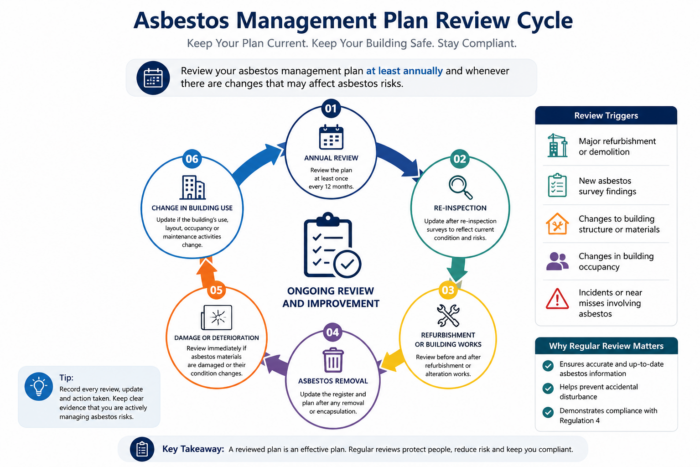
An asbestos management plan should be reviewed at least every 12 months and whenever there are significant changes to the building, asbestos-containing materials, or maintenance activities. Reviews help ensure the information remains accurate and effective.
Creating the management plan is only the beginning. Keeping it up to date is equally important.
Over time, buildings change. Maintenance is carried out, tenants move, refurbishments take place, and asbestos-containing materials can deteriorate. A plan that is several years old may no longer reflect the current risks.
For this reason, regular reviews are essential.
Annual Reviews
As a minimum, organisations should review their asbestos management plan every year.
During the review, consider whether:
- The asbestos register is still accurate.
- Previously identified ACMs remain in good condition.
- New surveys have been completed.
- Remedial actions have been carried out.
- Responsible personnel have changed.
- Emergency procedures remain appropriate.
- Contact details are current.
Even if no changes are required, documenting the review demonstrates ongoing compliance.
Additional Reviews Should Take Place When:
Following a Re-inspection Survey
A re-inspection survey provides updated information on the condition of asbestos-containing materials.
The management plan should be updated to reflect:
- Changes in condition
- Revised risk scores
- New inspection intervals
- Additional control measures
After Refurbishment or Building Alterations
Construction work may uncover previously hidden asbestos or alter the condition of existing materials.
Following refurbishment:
- Update the asbestos register.
- Record any removed materials.
- Amend site plans.
- Review contractor procedures.
After Asbestos Removal
Whenever asbestos has been removed, ensure the management plan records:
- Areas affected
- Removal dates
- Contractor details
- Clearance certificates
- Remaining ACMs
Maintaining accurate records prevents unnecessary confusion during future maintenance.
After Accidental Damage
If asbestos-containing materials are disturbed:
- Investigate the incident.
- Review risk assessments.
- Amend emergency procedures if required.
- Record corrective actions.
Following Changes in Occupancy
Changes in how a building is used may increase the likelihood of asbestos disturbance.
Examples include:
- Vacant offices becoming schools
- Storage areas becoming workshops
- Increased maintenance activity
- Higher public access
Risk assessments should reflect these operational changes.
Integrating an Asbestos Management Plan with Property Records
An asbestos management plan should not exist in isolation. It works best when integrated into the wider property management system.
By linking asbestos information with other compliance documents, organisations can improve decision-making, reduce duplication, and ensure everyone works from accurate, up-to-date information.
Key Documents That Should Work Together
A well-managed property should integrate the asbestos management plan with:
- Asbestos Register
- Fire Risk Assessment
- Health and Safety File
- Planned Preventative Maintenance (PPM) records
- Building logbook
- Asset management system
- Refurbishment records
- Maintenance schedules
- Contractor management system
- Building drawings and floor plans
When these documents are connected, facilities teams can quickly identify asbestos risks before any work begins.
How to Commission an Asbestos Management Plan
Commissioning an asbestos management plan involves appointing a competent asbestos surveyor, completing an Asbestos Management Survey, creating an asbestos register, carrying out risk assessments, and implementing procedures to monitor and manage asbestos-containing materials on an ongoing basis.
Whether you’re responsible for a single office or a portfolio of commercial properties, the process should follow a structured approach to ensure compliance with the Control of Asbestos Regulations 2012.
Step 1: Arrange an Asbestos Management Survey
The first step is to identify whether asbestos-containing materials (ACMs) are present within the building.
A competent asbestos surveyor will inspect accessible areas, identify suspected ACMs, and, where necessary, take samples for laboratory analysis.
The survey will provide information on:
- The location of ACMs
- The type of asbestos (where identified)
- Material condition
- Accessibility
- Likelihood of disturbance
- Material risk assessment
This survey forms the foundation of your asbestos management plan.
Step 2: Create or Update the Asbestos Register
Using the survey findings, an asbestos register should be prepared or updated.
The register records:
- Locations of ACMs
- Product types
- Material condition
- Risk ratings
- Inspection dates
- Recommended actions
It should be readily available to anyone responsible for maintaining or working within the building.
Step 3: Complete a Risk Assessment
Not all asbestos presents the same level of risk.
A competent assessor will evaluate:
- The condition of the material
- Its likelihood of being disturbed
- The way the building is used
- Occupancy levels
- Maintenance activities
This assessment helps determine the most appropriate management strategy.
Step 4: Prepare the Management Plan
Using the survey and risk assessment, the asbestos management plan should be developed.
It should clearly explain:
- Who is responsible for managing asbestos
- How asbestos risks will be controlled
- Inspection schedules
- Emergency procedures
- Communication arrangements for contractors
- Planned remedial works
- Review dates
The plan should be practical, easy to follow, and accessible to those who need it.
Step 5: Communicate the Information
An asbestos management plan is only effective if the relevant people know it exists.
Ensure that:
- Facilities managers understand their responsibilities.
- Maintenance staff can access the asbestos register.
- Contractors are informed before work begins.
- Relevant employees receive asbestos awareness training where appropriate.
Clear communication reduces the risk of accidental disturbance.
Step 6: Monitor and Review
Managing asbestos is an ongoing responsibility.
Continue to:
- Carry out regular inspections.
- Update the asbestos register.
- Review the management plan annually.
- Arrange re-inspection surveys.
- Record any changes to asbestos-containing materials.
Regular monitoring demonstrates a proactive approach to compliance.
Who Needs an Asbestos Management Plan?
An asbestos management plan is required for anyone responsible for maintaining non-domestic premises where asbestos-containing materials may be present. This includes commercial property owners, schools, NHS buildings, local authorities, industrial facilities, and other workplaces built before 2000.
Many organisations mistakenly believe asbestos management only applies to older industrial buildings. In reality, Regulation 4 covers a wide range of non-domestic premises.
Examples include:
- Schools
- NHS buildings
- Local authorities
- Offices
- Retail premises
- Warehouses
- Industrial buildings
If your organisation is responsible for repairing or maintaining these premises, you are likely to have duties under Regulation 4.
Common Mistakes That Put Organisations at Risk
Even organisations with an asbestos management plan can fall out of compliance if it is not maintained properly.
Here are some of the most common mistakes.
Assuming the Survey Is Enough
A survey identifies asbestos. It does not explain how it will be managed.
Without an asbestos management plan, organisations may struggle to demonstrate compliance during an HSE inspection.
Failing to Update the Asbestos Register
Asbestos registers should be updated whenever:
- Re-inspection surveys are completed
- Asbestos is removed
- New ACMs are identified
- The condition of existing materials changes
An outdated register can lead to unsafe decisions during maintenance work.
Not Informing Contractors
Maintenance contractors should always be made aware of asbestos before starting work.
Providing access to the asbestos register and management plan helps prevent accidental disturbance.
Missing Annual Reviews
An asbestos management plan should be treated as a live document.
Reviewing it every year helps ensure:
- Information remains accurate
- Responsibilities are current
- Inspection schedules are followed
- Control measures remain effective
Ignoring Damaged Asbestos
If asbestos-containing materials become damaged, immediate action should be taken to assess the risk.
Ignoring deterioration increases the likelihood of fibre release and may require emergency remedial work.
Using Outdated Survey Information
Buildings change over time.
Extensions, refurbishments, alterations, and maintenance work can all affect asbestos risks.
Ensure survey information reflects the current condition of the property.
How ACS Can Help
Managing asbestos is an ongoing legal responsibility, but it doesn’t have to be complicated.
At Asbestos Compliance Solutions (ACS), we work with commercial organisations, public sector bodies, and property managers across the UK to help them meet their obligations under the Control of Asbestos Regulations 2012.
Our services include:
- Asbestos Management Surveys
- Refurbishment and Demolition Surveys
- Asbestos Re-inspection Surveys
- Asbestos Registers
- Bespoke Asbestos Management Plans
- Air Monitoring and Four-Stage Clearance
- Licensed Asbestos Removal
- Ongoing Compliance Support
Whether you manage a single building or a multi-site property portfolio, our experienced team can help you develop a practical asbestos management strategy that protects occupants, supports maintenance programmes, and demonstrates legal compliance.
Need help creating or reviewing your asbestos management plan? Contact ACS to arrange a survey or speak with one of our asbestos compliance specialists.
Frequently Asked Questions
Yes. Under Regulation 4 of the Control of Asbestos Regulations 2012, duty holders must have arrangements in place to manage asbestos risks. A documented management plan is a key part of demonstrating compliance.
The duty holder is responsible for ensuring an asbestos management plan is prepared, implemented, and reviewed. This may be a building owner, landlord, facilities manager, employer, or managing agent, depending on who has responsibility for maintenance and repair.
The plan should be reviewed at least every 12 months and whenever there are significant changes, such as refurbishment work, asbestos removal, damage to asbestos-containing materials, or changes in how the building is used.
No. An asbestos survey identifies asbestos-containing materials, while the management plan explains how those materials will be monitored and managed over time.
Yes. If asbestos-containing materials are in good condition and are unlikely to be disturbed, they can often remain in place and be managed safely through regular inspections and appropriate control measures.
Work should stop immediately, access to the area should be restricted, and the incident should be reported to the responsible person. A competent asbestos professional should assess the situation and recommend the appropriate next steps.
Buildings constructed before 2000 that may contain asbestos and fall under the duty to manage requirements should have appropriate arrangements in place, including an asbestos management plan where applicable.
Yes. Anyone carrying out maintenance, installation, or refurbishment work should be provided with relevant asbestos information before work begins to reduce the risk of accidental disturbance.
A new survey may be required before refurbishment or demolition works, or if there is reason to believe the existing survey no longer accurately reflects the condition of the building.