





Asbestos Re-Inspection Frequency Under CAR 2012
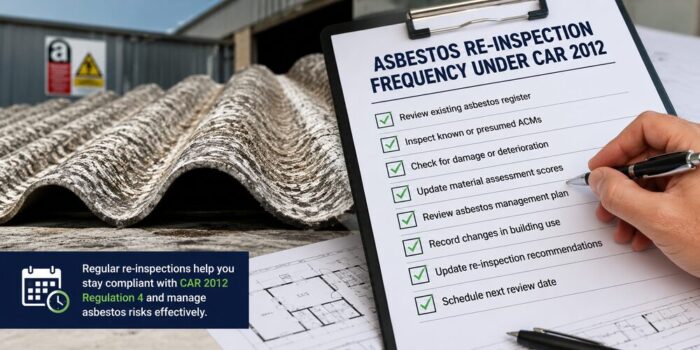
Many duty holders assume that once an asbestos survey has been completed, no further action is required. However, asbestos management is an ongoing responsibility. If asbestos-containing materials (ACMs) remain within a building, their condition must be monitored and reviewed regularly.
Over time, asbestos materials can deteriorate, become damaged during maintenance works, or be affected by changes in how a building is used. This is why asbestos re-inspections play an important role in maintaining compliance and protecting building occupants.
Understanding the correct asbestos re-inspection frequency is essential for anyone responsible for managing commercial, industrial, educational, healthcare or public sector premises, as well as the common parts of multi-occupancy domestic buildings.
In this article, we explain what asbestos re-inspections involve, how often they should be carried out, and how businesses can stay compliant with their legal responsibilities.
What Is an Asbestos Re-Inspection?
An asbestos re-inspection is a follow-up assessment of previously identified or presumed asbestos-containing materials.
The purpose is to check whether the condition of the material has changed since the last inspection and whether the risk assessment remains accurate.
During a re-inspection, a competent asbestos surveyor will review the asbestos register, inspect known or presumed ACMs, assess any deterioration, and update records where required.
It is important to understand the difference between:
- An initial asbestos survey, which identifies ACMs within a building.
- An asbestos re-inspection, which reviews the condition of known or presumed ACMs.
- An asbestos management plan review, which ensures management arrangements remain effective.
If your property has not yet been surveyed, ACS can assist with asbestos surveys, sampling and management advice across a wide range of commercial and public sector premises.
What Does CAR 2012 Regulation 4 Require?
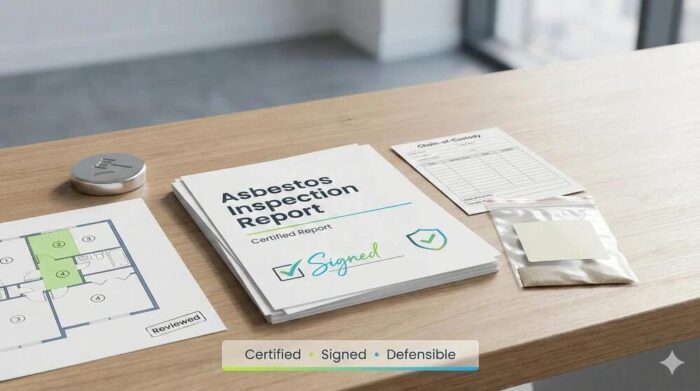
Regulation 4 of the Control of Asbestos Regulations 2012 applies to non-domestic premises and to the common parts of multi-occupancy domestic premises, such as communal corridors, stairwells, plant rooms and service risers.
Under Regulation 4, duty holders must identify, or presume the presence of, asbestos-containing materials where appropriate, maintain an up-to-date asbestos register, assess the risk of exposure, and regularly review asbestos management arrangements. This includes monitoring the condition of known or presumed asbestos-containing materials through periodic re-inspections.
This duty applies to many types of premises, including:
- Offices
- Industrial units
- Retail premises
- Schools and colleges
- Healthcare facilities
- Warehouses
- Public buildings
- Common parts of multi-occupancy domestic premises
The regulation requires duty holders to:
- Determine whether asbestos is present, or presume that it is present where appropriate.
- Maintain an up-to-date asbestos register.
- Assess the risk posed by known or presumed ACMs.
- Implement an asbestos management plan.
- Monitor the condition of asbestos-containing materials.
- Review management arrangements regularly.
In simple terms, finding asbestos is only the first step. Duty holders must continue to monitor its condition and ensure it remains safely managed.
Failing to review asbestos information can leave organisations exposed to compliance issues and potential enforcement action.
How Often Should Asbestos Be Re-Inspected?
There is no single asbestos re-inspection frequency that applies to every building or every asbestos-containing material.
Under CAR 2012, duty holders are required to manage asbestos risks, keep asbestos information up to date, monitor the condition of known or presumed ACMs, and review their asbestos management arrangements. In practical terms, this means re-inspection intervals should be risk-based and recorded within the asbestos management plan.
As a general rule, many organisations arrange asbestos re-inspections annually. However, some materials may require more frequent checks, particularly where they are damaged, deteriorating, located in busy areas, or likely to be disturbed by maintenance activity.
The correct frequency should consider:
- The type of asbestos-containing material
- Its condition
- Its location and accessibility
- The likelihood of disturbance
- Occupancy levels
- Maintenance activity
- Previous history of damage or deterioration
Higher-risk materials such as sprayed coatings, pipe lagging, thermal insulation and asbestos insulation board may require more frequent monitoring, often every 6 to 12 months depending on their condition and location.
Lower-risk materials such as asbestos cement, vinyl floor tiles, textured coatings and bitumen-based products may be suitable for annual monitoring where they are in good condition and unlikely to be disturbed. Longer intervals should only be used where justified by the risk assessment and supported by the asbestos management plan.
The asbestos register and management arrangements should be reviewed at least annually, and sooner if anything changes that could affect the risk from asbestos-containing materials.
Factors That Influence Re-Inspection Frequency
Every building is different. The condition of asbestos-containing materials can be affected by a range of factors, which is why the appropriate asbestos re-inspection frequency can vary from one property to another. Every building is different. The condition of asbestos-containing materials can be affected by a range of factors.
Material Condition
Materials that are cracked, damaged, or showing signs of deterioration may require more frequent monitoring than materials in good condition.
Occupancy Levels
Busy buildings generally present a higher likelihood of accidental disturbance.
Schools, hospitals, offices and public buildings often require closer monitoring than rarely accessed storage facilities.
Maintenance Activities
Regular maintenance work can increase the risk of disturbing ACMs.
Buildings undergoing refurbishment projects may require more frequent reviews to ensure asbestos information remains current.
Accessibility
Materials located in plant rooms, service risers or maintenance areas may be at greater risk of disturbance than materials located in sealed or inaccessible locations.
Previous History
Where materials have shown signs of deterioration in the past, a shorter inspection interval may be recommended.

Get Your Quote
Need an Asbestos Re-Inspection?
ACS helps businesses, schools and property managers stay compliant with professional asbestos re-inspections, updated registers and ongoing management support.
What Happens During an Asbestos Re-Inspection?
A re-inspection is usually a visual condition assessment of previously identified or presumed ACMs. It does not normally involve intrusive inspection or sampling unless new suspect materials are identified, previous records are unclear, or the scope of the visit requires further investigation.
Regular reviews help ensure the chosen asbestos re-inspection frequency remains suitable for the condition and risk profile of the materials identified within the building.
The surveyor will typically:
- Review the existing asbestos register.
- Locate previously identified or presumed materials.
- Assess their condition.
- Identify any signs of damage or deterioration.
- Update material assessments where required.
- Review recommendations from previous inspections.
- Update management records.
Following the inspection, the asbestos register should be updated and the findings incorporated into the property’s asbestos management arrangements.
ACS also supports organisations with ongoing asbestos management services, helping duty holders keep their records current and compliant.
Why Re-Inspections Matter
Some asbestos-containing materials can remain in place for many years without presenting a significant risk.
Following an appropriate asbestos re-inspection frequency helps organisations identify changes before they develop into more significant compliance or safety concerns.
Without regular inspections, organisations may be unaware that:
- Materials have become damaged.
- Maintenance work has disturbed ACMs.
- Building usage has changed.
- Existing risk assessments are no longer accurate.
- Previously presumed or recorded materials are no longer being managed appropriately.
An outdated asbestos register can create significant compliance risks and may leave employees, contractors and visitors exposed to avoidable hazards.
Regular inspections help ensure that management decisions continue to reflect the actual condition of asbestos within the building.
Consequences of Missing Re-Inspections
Failure to monitor asbestos can have serious consequences.
Potential issues include:
Compliance Failures
Duty holders may struggle to demonstrate compliance with Regulation 4 if asbestos information has not been reviewed for several years.
Increased Exposure Risk
Damaged ACMs may release fibres without being identified promptly.
Enforcement Action
The Health and Safety Executive (HSE) has the authority to investigate failures in asbestos management and take enforcement action where necessary.
Project Delays
Outdated asbestos information can delay maintenance projects, refurbishments and contractor activities.
Reputational Damage
Organisations that fail to manage asbestos appropriately may face reputational consequences alongside regulatory concerns.
How a Compliance Reminder Programme Can Help
One of the biggest challenges for duty holders is simply keeping track of inspection dates.
Many organisations manage multiple sites, contractors, maintenance schedules and compliance obligations simultaneously. It is easy for re-inspection deadlines to be overlooked.
A compliance reminder programme helps organisations stay on top of their asbestos responsibilities by providing timely reminders when reviews or inspections are due. This makes it much easier to maintain the correct asbestos re-inspection frequency across one or multiple sites.
Benefits include:
- Improved compliance management.
- Reduced risk of missed inspections.
- Better record keeping.
- More accurate asbestos registers.
- Greater confidence when dealing with contractors and regulators.
Rather than reacting when issues arise, organisations can take a proactive approach to asbestos management.
When Should You Arrange Your Next Re-Inspection?
Understanding your required asbestos re-inspection frequency can help prevent compliance gaps and ensure asbestos records remain up to date.
You should consider arranging a re-inspection or management review if:
- Your asbestos register or management plan has not been reviewed within the recommended timeframe, usually at least annually.
- The building has undergone maintenance or refurbishment works.
- Occupancy levels have changed significantly.
- Previously identified or presumed ACMs show signs of deterioration.
- Recommendations from a previous survey or re-inspection are due for review.
- You are unsure whether your asbestos management arrangements remain current.
If any of these apply, it may be time to review your asbestos records and arrange an inspection.
Need Help Staying Compliant?
Asbestos management is an ongoing responsibility, not a one-off exercise. Maintaining the correct asbestos re-inspection frequency helps ensure asbestos-containing materials remain in a safe condition, asbestos registers stay up to date, and duty holders continue to meet their obligations under CAR 2012.
Regular re-inspections allow organisations to identify deterioration early, review existing control measures, and keep asbestos management plans accurate. They also provide confidence that contractors, employees and building occupants are being protected from unnecessary exposure risks.
ACS provides asbestos surveying, asbestos re-inspections, asbestos management support, and compliance assistance for organisations across a wide range of sectors. We can also help you stay on top of upcoming review dates through our compliance reminder programme, reducing the risk of missed inspections and helping you maintain ongoing compliance.
If you would like to discuss an asbestos re-inspection, review your asbestos management arrangements, or learn more about our compliance reminder programme, please contact ACS today.
FAQs
There is no single asbestos re-inspection frequency that applies to every building. The frequency should be based on the type, condition and location of the asbestos-containing material, as well as the likelihood of disturbance. Many organisations review asbestos annually, while higher-risk materials may require inspections every 6–12 months.
No. CAR 2012 does not set a fixed asbestos re-inspection frequency. Instead, Regulation 4 requires duty holders to monitor the condition of asbestos-containing materials and review their asbestos management arrangements regularly.
An asbestos re-inspection typically involves reviewing the asbestos register, assessing the condition of known or presumed asbestos-containing materials, identifying any deterioration, and updating management records where required.
An asbestos management plan should be reviewed regularly and whenever there are significant changes to the building, occupancy levels, maintenance activities or the condition of asbestos-containing materials. Many organisations review their management plans annually.
Missing asbestos re-inspections can result in outdated asbestos records, increased risk of accidental disturbance, compliance issues, project delays and potential enforcement action if asbestos is not being managed appropriately.