




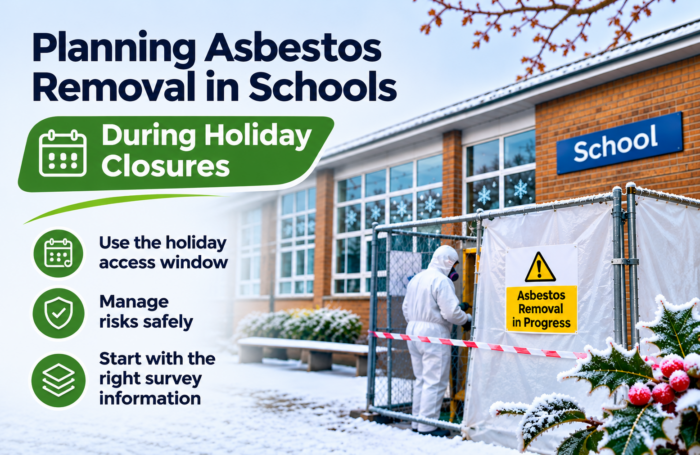
Planning Asbestos Removal in Schools During Holiday Closures
School holidays can provide a useful opportunity to complete building work with fewer pupils and staff on site. For estates managers, facilities teams and school business managers, the Christmas closure may be a suitable time to arrange specialist asbestos work.
However, a closed school does not remove the need for proper safety controls. Planning asbestos removal in school buildings requires early preparation, competent contractors and enough time to complete the work safely.
The priority should not simply be finishing before the new term. The school must be able to reopen with the necessary checks, records and handover arrangements in place.
Why asbestos may be present in school buildings
Asbestos was widely used in construction materials during the twentieth century. The Health and Safety Executive (HSE) confirms that it was used extensively in schools and other public buildings before its use was completely banned in Great Britain in 1999.
Schools built or refurbished before 2000 may therefore contain asbestos-containing materials (ACMs).
Finding asbestos does not automatically mean it must be removed. If the material is in good condition and unlikely to be disturbed, it may be safer to manage it in place, monitor its condition and keep the relevant information available to staff and contractors.
Removal or other remedial action may be necessary if the material is damaged, deteriorating or likely to be disturbed by planned building work.
When should schools consider asbestos removal in school buildings?
The decision should be based on the material’s condition, location and likelihood of disturbance. A competent surveyor can identify materials that need monitoring, further investigation or remedial action.
Before arranging asbestos removal in school buildings, the responsible organisation should review the survey findings and establish whether removal is necessary or whether the material can be managed safely in place.
Removal may be considered where ACMs are damaged, vulnerable to accidental disturbance or located in an area affected by planned refurbishment. Encapsulation or other management measures may sometimes be suitable alternatives.
Schools should record the reasons for their decision and any follow-up actions within their asbestos management arrangements.
Why holiday timing needs careful coordination
School closures can make specialist work easier to schedule, but short holiday periods can create pressure. Survey results, approvals, contractor availability and other building projects may all affect the programme.
For a Christmas closure, confirm the dates when the building will be available and whether caretakers, cleaners or other contractors will be on site. Agree how the work area will be isolated, who will control access and how programme changes will be communicated.
Planning asbestos removal in school buildings should also allow sufficient time for the work, required checks and a safe handover before pupils return.
The work should never be rushed to meet a holiday deadline. If the necessary controls and completion arrangements cannot be achieved within the available period, reconsider the programme.
Start with the right survey information
Before refurbishment or removal work begins, check whether the existing asbestos survey covers the proposed work.
A management survey helps identify and manage asbestos during normal occupation. It may not identify materials hidden behind walls, ceilings, floors or other building elements.
Where refurbishment or demolition is planned, a refurbishment or demolition survey may be required for the affected area. This is more intrusive and usually requires the relevant area to be vacant.
Before asbestos removal in school buildings is authorised, review the survey report carefully. Check the location and condition of the ACMs, any inaccessible areas and the recommended actions. If the scope of work has changed, seek further advice before proceeding.
HSE guidance also recommends providing asbestos information to contractors early, including when requesting quotations.
Choosing the right contractor
Schools should appoint contractors who are competent and suitably qualified for the specific work. Some asbestos work requires an HSE licence, while other work may be non-licensed or notifiable non-licensed work.
When planning asbestos removal in school buildings, establish:
- Whether the work requires an HSE-licensed contractor.
- What relevant training, experience and insurance the contractor holds.
- How the work area will be isolated and access controlled.
- What method of work, risk assessment and notifications are required.
- How asbestos waste will be packaged, transported and disposed of.
- What checks and handover documentation will be provided.
If other trades are working during the closure, coordination is essential. Electricians, roofers, heating engineers and maintenance teams must receive relevant asbestos information before entering or working in affected areas.
What are the school’s legal responsibilities?
The Control of Asbestos Regulations 2012 apply to the management of asbestos in non-domestic premises, including schools.
The dutyholder is generally the person or organisation responsible for maintenance or repair. Depending on the school’s arrangements, this may be a local authority, academy trust, governing body or proprietor.
The dutyholder must ensure asbestos risks are assessed and managed, records are maintained and relevant information is shared with people who may disturb asbestos.
The HSE’s report on school asbestos management in 2022/23 found that 7% of inspected schools had significant failings requiring enforcement action. This highlights the importance of keeping asbestos management arrangements up to date.
A practical checklist before the school closes
Use this checklist to prepare for planned asbestos work:
- Confirm the recommendation: Understand why removal or remedial work is needed and whether managing the material in place is an alternative.
- Check the survey: Make sure the information covers the proposed work.
- Secure approvals: Follow the school’s or trust’s procurement and authorisation process.
- Agree the programme: Confirm dates, access arrangements and contingency plans.
- Appoint competent contractors: Check licensing requirements and suitability.
- Coordinate other trades: Share relevant asbestos information with everyone involved.
- Plan site controls: Agree restricted areas, access arrangements and emergency contacts.
- Confirm handover requirements: Establish what checks and records are needed before the area returns to use.
Any asbestos removal in school premises should have clear completion and handover arrangements agreed before work starts.
Preparing the building for reopening
Before pupils and staff return, the responsible person should confirm that the work has been completed in line with the agreed scope and that the required documentation has been received.
Where applicable, check the necessary clearance certification and other handover evidence. Update the asbestos register to show what has been removed and what remains. Retain relevant survey reports, waste documentation and contractor records.
After asbestos removal in school buildings, the affected area should not return to normal use until the appropriate checks and controls have been completed.
If unexpected materials are discovered or suspected asbestos is disturbed, work should stop where necessary. Keep people away from the affected area and arrange assessment by competent professionals.
Plan early for the Christmas closure
Holiday access is often planned alongside heating repairs, electrical upgrades and general maintenance. Identifying asbestos requirements early gives schools more time to arrange surveys, approvals and specialist contractors.
ACS can discuss asbestos survey requirements for school buildings and help identify the information needed before planned works. Contact the team with details of your site, proposed project and intended closure dates.
Need advice about asbestos work at your school? Contact ACS to discuss your requirements.
Frequently asked questions
It may be possible, provided the work is properly planned, suitable contractors are available and the necessary controls and handover arrangements can be completed. The holiday period does not reduce the legal requirements for safe asbestos work.
No. Materials in good condition that are unlikely to be disturbed can often be managed in place. The decision should follow a suitable assessment of condition, risk and planned activities.
The existing survey should be checked against the planned work. If it does not cover the area or the proposed activity, further survey work may be needed. Refurbishment or demolition projects often require a more intrusive survey of the affected area.
No. Licensing requirements depend on the type and circumstances of the work. Some work must be carried out by an HSE-licensed contractor, while other work may be non-licensed or notifiable non-licensed work. The correct category should be established before work starts.
The responsible person should check that the work is complete, required clearance or handover evidence has been received where applicable, records have been updated and any outstanding issues are resolved. The area should not be returned to use until the appropriate checks and controls have been completed.